Description
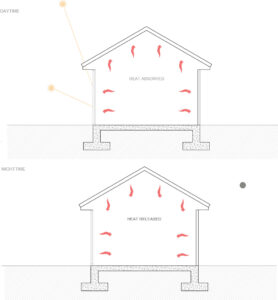
Phase Change Materials (PCM) store and release thermal energy through a reversible phase transition, typically within the indoor comfort temperature range. As temperatures rise, the material absorbs latent heat while changing phase; when temperatures fall, it releases the stored heat and returns to its initial state.
Integrated into walls, ceilings, floors, façade components or HVAC systems, PCM can reduce and delay indoor temperature peaks during heatwaves, provided that sufficient night-time or active cooling is available to regenerate the material.
Image
Please download the PDF to have the information sent directly to your email address.
Healthcare Waste Insulation
Send download link to:
Implementation Guide
- Define the thermal objective and select a phase-change temperature suited to the indoor comfort range and local climate
- Select the appropriate PCM type, encapsulation system and installation location
- Place PCM where effective heat exchange with indoor air or building systems can occur
- Ensure regeneration through night ventilation, free cooling or controlled mechanical cooling
- Verify fire safety, leakage resistance, material compatibility and long-term cycling stability
- Validate performance using dynamic thermal simulation
Benefits and Limitations
Benefits
- Provides high thermal storage capacity with limited additional mass
- Reduces and delays indoor temperature peaks
- Can reduce peak cooling loads and improve thermal comfort
- Suitable for lightweight buildings and retrofit applications
- Can be integrated into multiple construction and HVAC systems
Limitations
- Performance depends on correct phase-change temperature and system sizing
- Requires regular thermal regeneration to remain effective
- Prolonged heatwaves may reduce performance if the PCM remains fully melted
- Higher cost than conventional thermal-mass solutions
- Fire, leakage and long-term stability depend on the encapsulation system
Parameter and data
Design PCM system designed according to the required thermal-storage capacity, indoor comfort range and expected heatwave conditions, with sufficient heat-exchange area and a defined regeneration strategy
Materials and Components
- Paraffin-based PCM
- Salt hydrates
- Fatty acids
- Bio-based PCM
- Micro- or macroencapsulation systems
- Shape-stabilized PCM
- Polymer encapsulation
- Graphite or metallic conductivity enhancers where required
Application Internal walls, ceilings, floors, façade panels, roofs, HVAC components and thermal-storage modules, particularly in lightweight buildings with limited conventional thermal mass
Technical Properties
- Phase-change temperature: Typically selected around 18–28 °C for comfort applications, depending on climate and operational strategy
- Format/thickness: boards and panels commonly 10–50 mm, while capsules and admixtures vary according to product and application
Thermal-storage capacity depends on PCM type, quantity, encapsulation and phase-change temperature
Thermal / Cooling Performance Provides latent thermal storage that can reduce and delay indoor temperature peaks and shift cooling loads
Performance can reach high levels when properly sized and regenerated, but decreases significantly if the PCM remains fully charged during prolonged heat events
Operation Passive or hybrid, passive thermal storage with regeneration through night ventilation, free cooling or mechanical cooling where required
Advantages Provides high thermal-storage density with relatively little additional weight and can be integrated into a wide variety of building systems
Applicability Criteria Suitable for buildings with high overheating risk, particularly lightweight constructions with limited thermal mass
Most effective where daily temperature variation or an active cooling strategy allows the PCM to regenerate between heat cycles
Less effective during prolonged periods where temperatures remain continuously above the phase-change range
Expected Service Life 20–30+ years, depending on PCM chemistry, encapsulation quality, cycling stability and installation conditions
Please download the PDF to have the information sent directly to your email address.
Healthcare Waste Insulation
Send download link to: