
Description
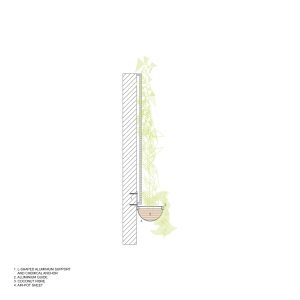
Vegetated cooling façades are vertical greening systems designed to reduce solar heat gains through shading, evapotranspiration and thermal buffering.
Systems can range from climbing vegetation on trellises to modular or hydroponic green walls. During heatwaves, vegetation can reduce façade surface temperatures and improve the surrounding microclimate while also providing biodiversity and visual benefits.
Image
Please download the PDF to have the information sent directly to your email address.
Healthcare Waste Insulation
Send download link to:
Implementation Guide
- Assess solar exposure, climate, wind and structural capacity
- Select climbing, modular or hydroponic systems according to project needs
- Provide suitable structural support, irrigation and drainage where required
- Select vegetation according to orientation and water demand
- Protect the primary façade from persistent moisture
- Ensure access for vegetation and system maintenance
Benefits and Limitations
Benefits
- Reduces façade surface temperatures and solar heat gains
- Provides shading and evapotranspirative cooling
- Improves urban microclimate and biodiversity
- Can improve indoor thermal comfort
- Offers architectural and landscape value
Limitations
- Cooling depends on vegetation health and water availability
- Irrigation and maintenance may be significant.
- Modular systems can add substantial structural load
- Poor drainage can create moisture-related problems
- Performance varies strongly with climate and system type
Parameter and data
Design: Vertical greening system designed according to façade orientation, solar exposure, structural capacity, vegetation type, water demand and maintenance requirements
The selected configuration may range from low-tech climbing vegetation to intensive modular green-wall systems
Materials and Components: Depending on system type:
- Climbing vegetation
- Trellis or cable systems
- Modular green-wall panels
- Hydroponic systems
- Growing substrate or inert support media
- Metal frames and anchoring systems
- Irrigation and drainage components
Technical Properties:
- Saturated weight: Approximately 40–80 kg/m²
- Overall system thickness: Approximately 100–300 mm
- Water consumption: Approximately 2–5 l/m²/day
- Plant coverage: Approximately 70–100%, depending on vegetation and maintenance
Simpler climbing-plant systems may have substantially lower weight, thickness and water demand
Thermal / Cooling Performance: Can reduce façade surface temperatures through shading and evapotranspiration
Indicative reductions of approximately 5–15 °C may occur under suitable conditions, but actual performance depends strongly on vegetation density, water availability, solar exposure, humidity and wind
Operation: Passive cooling with variable technical support, climbing systems may operate almost entirely passively, while modular and hydroponic systems usually require active irrigation and drainage control
Advantages: Provides solar shading, evapotranspirative cooling and ecological benefits within a façade-integrated system, with solutions ranging from simple low-tech vegetation to intensive modular green walls
Applicability Criteria: Suitable for solar-exposed façades where structural capacity is adequate, vegetation can be maintained, irrigation and drainage can be provided where required, maintenance access is available
The system type should be selected according to available water, maintenance capacity and desired vegetation density
Expected Service Life: Approximately 15–30 years for the main vegetated façade system, depending on system type and maintenance
Vegetation, irrigation components and individual modules may require earlier replacement, while structural supports can last longer
Please download the PDF to have the information sent directly to your email address.
Healthcare Waste Insulation
Send download link to:





