Description
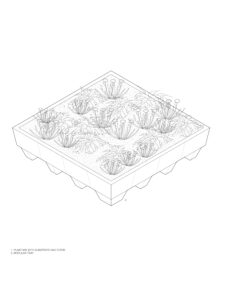
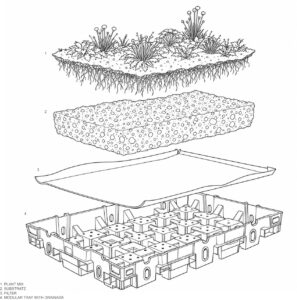
Extensive green roof trays are modular vegetated roof systems composed of prefabricated units integrating drainage, temporary water storage, lightweight growing substrate and vegetation.
Their modular configuration allows rapid installation, partial replacement and flexible coverage while providing passive roof cooling, stormwater retention and biodiversity benefits.
Image
Please download the PDF to have the information sent directly to your email address.
Healthcare Waste Insulation
Send download link to:
Implementation Guide
- Verify roof structural capacity considering saturated system weight
- Ensure compatible waterproofing and root-protection layers
- Install trays with continuous drainage and safe overflow paths
- Select substrate and vegetation according to local climate
- Provide irrigation where establishment or prolonged drought requires it
- Inspect vegetation, drainage and roof protection periodically
Benefits and Limitations
Benefits
- Reduces roof surface temperatures through shading and evapotranspiration
- Provides stormwater retention and delayed runoff
- Modular system allows easy installation and replacement
- Suitable for new construction and many retrofit projects
- Supports biodiversity and improves roof microclimate
Limitations
- Heavier than mat-based extensive green roofs
- Plant diversity is limited by shallow substrate depth
- Thermal and hydrological performance depends on water availability
- Irrigation may be required during prolonged drought
- Structural capacity and waterproofing must be verified
Parameter and data
Design Modular extensive green roof system using self-contained vegetated trays installed over a protected waterproofing and root-barrier layer
Design should consider saturated load, roof slope, drainage capacity, wind exposure and local climatic conditions
Materials and Components
- Modular trays, often recycled HDPE
- Lightweight engineered substrate
- Drought-tolerant vegetation
- Drainage and temporary water-storage layers
- Root barrier
- Waterproofing membrane
- Irrigation system where required
Application Flat or low-slope roofs, terraces and non-accessible roofs in both new construction and retrofit projects
Technical Properties
- Saturated weight: Approximately 50–120 kg/m²
- Substrate thickness: Approximately 70–100 mm
- Overall system thickness: Approximately 120–200 mm
- Water-retention capacity: Approximately 30–50 l/m²
- Plant coverage: Typically ≥90% for pre-vegetated systems
- Rainfall retention: Approximately 50–80% under suitable conditions, but highly dependent on climate, rainfall event and initial substrate moisture
Thermal / Cooling Performance Reduces roof surface temperature through vegetation shading and evapotranspiration and can contribute to lower heat transfer through the roof
Actual heatwave performance depends on vegetation health, substrate moisture, solar exposure, roof insulation and climate
Operation Passive, with irrigation used where required for establishment or drought periods
Advantages Provides a modular and replaceable green-roof solution with greater water-storage capacity than thin vegetation mats while retaining relatively low maintenance requirements
Applicability Criteria Suitable for flat or low-slope roofs with sufficient structural capacity for saturated loads
Particularly appropriate where modular installation, replacement flexibility and moderate stormwater retention are desired
Structural capacity, waterproofing, drainage and wind resistance should be checked before installation
Expected Service Life Approximately 20–30 years for the main modular green-roof system
Please download the PDF to have the information sent directly to your email address.
Healthcare Waste Insulation
Send download link to: