Description
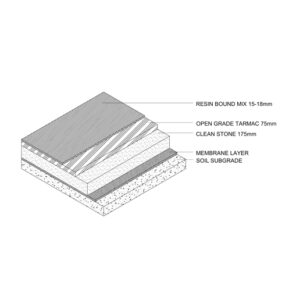
Resin-bound gravel is a porous paving system made by mixing clean aggregates with resin to create a continuous, permeable surface. Water passes through the surface into the underlying layers, where it can be temporarily stored, drained or infiltrated into the ground.
For full hydrological performance, the resin-bound surface must be installed over a permeable base and sub-base designed according to expected runoff and site drainage conditions.
Image
Please download the PDF to have the information sent directly to your email address.
Healthcare Waste Insulation
Send download link to:
Implementation Guide
- Assess runoff, soil permeability, groundwater conditions and expected surface loads
- Install the resin-bound surface over a permeable, open-graded base where infiltration or temporary storage is required
- Size the underlying drainage or storage layer according to expected rainfall conditions
- Provide suitable slopes and a safe overflow or drainage route
- Use washed, dry aggregates and compatible UV-stable resin
- Periodically clean the surface and inspect for clogging, cracking or resin deterioration
Benefits and Limitations
Benefits
- Reduces surface runoff and supports stormwater management
- Provides a smooth, accessible and visually adaptable surface
- Can promote infiltration and temporary water storage when installed over a permeable build-up
- Suitable for pedestrian and light-traffic applications
Limitations
- Hydrological performance depends on the permeability of the complete pavement build-up
- Surface pores may become clogged without regular cleaning
- Resin deterioration can reduce durability and permeability over time
- Not suitable for heavy-traffic applications unless specifically engineered
- Resin content limits recyclability compared with unbound aggregate systems
Parameter and data
Design: Continuous porous surface formed from resin-bound aggregates over a permeable open-graded base and sub-base where infiltration or temporary stormwater storage is required
Materials and Components:
- Washed and dried natural aggregates
- Polyurethane resin suitable for outdoor exposure
- Open-graded aggregate base and sub-base
- Porous asphalt or concrete base where appropriate
- Primer or bonding layer where required
- Optional geotextile depending on subgrade conditions
Application: Pedestrian areas, pathways, courtyards, parks, driveways and other light-traffic surfaces integrated into sustainable drainage systems
Thickness: Surface layer: typically 1.5–3 cm – Permeable base/sub-base: typically 15–50+ cm, depending on structural and stormwater-storage requirements
Permeability: Moderate–High, depending on aggregate grading, resin content, installation quality and the permeability of the underlying layers
Advantages: Smooth and accessible surface with good aesthetic flexibility and the potential to combine pavement use with stormwater infiltration or temporary storage
Maintenance: Medium: periodic surface cleaning to prevent clogging, together with inspection for cracking, loss of permeability and resin deterioration
Environmental Impact: Medium: the permeable system can reduce runoff and drainage demand, but the resin component increases material impacts and limits recyclability compared with unbound mineral surfaces
Applicability Criteria: Suitable for pedestrian areas, paths, courtyards, driveways and light-traffic surfaces where a permeable pavement system can be accommodated. For infiltration applications, the underlying base, subgrade and groundwater conditions must also be suitable. Heavy-traffic applications require specifically engineered systems
Expected Service Life: 15–25 years, depending on resin quality, installation, traffic, exposure conditions and maintenance
Please download the PDF to have the information sent directly to your email address.
Healthcare Waste Insulation
Send download link to: