
Description
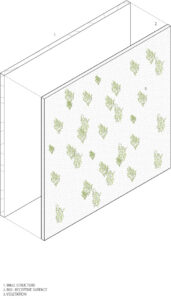
Bio-receptive surfaces are building materials and façade systems designed to encourage the natural colonization and growth of organisms such as mosses, lichens, algae and other microorganisms.
Through controlled surface roughness, porosity, moisture retention and material composition, these systems can support biodiversity while contributing to passive cooling through shading, evaporation and biological moisture processes. They can also improve the ecological integration of buildings and urban surfaces.
Image
Please download the PDF to have the information sent directly to your email address.
Healthcare Waste Insulation
Send download link to:
Implementation Guide
- Identify surfaces with suitable solar exposure, humidity and rainfall conditions
- Select materials and surface properties according to the target biological community
- Define whether colonization will occur naturally or through pre-seeded systems
- Provide moisture-retention or irrigation systems where required
- Ensure compatibility with structural, waterproofing and drainage systems
- Monitor biological development and control unwanted species where necessary
Benefits and Limitations
Benefits
- Can reduce surface temperatures through biological and evaporative cooling
- Enhances urban biodiversity and ecological connectivity
- Improves microclimatic conditions around buildings
- Requires little operational energy
- Can provide distinctive architectural and ecological value
Limitations
- Cooling performance depends strongly on moisture availability
- Biological colonization may take time to establish
- Appearance and coverage can vary over time
- Performance depends on climate, orientation and species
- Some systems may require supplemental irrigation and ecological management
Parameter and data
Design Surface system designed to promote controlled biological colonization through optimized porosity, roughness, moisture retention and material chemistry
Design should consider climate, orientation, water availability, desired species and compatibility with the underlying façade or structural system
Materials and Components
- Bio-receptive concrete
- Porous ceramic materials
- Mineral composites
- Textured stone-based materials
- Recycled mineral aggregates
- Water-retention or capillary layers where required
- Supplemental irrigation systems where necessary
Application Façades, retaining walls, acoustic barriers, urban furniture, public-space elements and landscape structures
Technical Properties
- Biological layer: Typically around 0.1–2 mm, depending on organisms and surface condition
- Substrate or bio-receptive layer: Approximately 15–50 mm, depending on system type
Key properties include: Surface porosity, moisture retention, biological colonization potential, passive cooling and biodiversity enhancement
Thermal / Cooling Performance Can reduce surface temperatures through a combination of biological coverage, moisture retention and evaporation
Indicative surface-temperature reductions of approximately 3–15 °C, but actual performance depends strongly on moisture availability, climate and biological coverage
Operation Primarily passive, biological colonization develops naturally or through pre-seeded systems
Some applications may incorporate passive water-retention systems or supplemental irrigation
Advantages Combines passive microclimatic cooling with biodiversity enhancement and ecological integration directly within building and urban surfaces
Applicability Criteria Suitable for façades and urban surfaces where sufficient moisture, suitable orientation and compatible substrate conditions can support biological colonization
Less suitable where surfaces must remain completely dry, where water availability is very limited, or where biological growth is incompatible with architectural or maintenance requirements
Expected Service Life 15–30 years for the main panel or substrate system
Biological communities are dynamic and can evolve, regenerate or change continuously throughout the service life of the system
Please download the PDF to have the information sent directly to your email address.
Healthcare Waste Insulation
Send download link to:





