Description
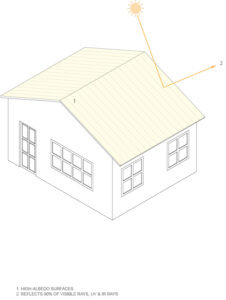
Cool roofs are roofing systems designed with high solar reflectance and high thermal emissivity to reduce the amount of solar energy absorbed by the roof surface.
Compared with conventional dark roofs, they can maintain significantly lower surface temperatures during hot periods, reducing heat transfer into the building and helping limit overheating and cooling demand during heatwaves.
They can be implemented through reflective coatings, reflective roofing membranes, light-coloured tiles or mineral finishes, and other high-reflectance roofing systems.
Image
Please download the PDF to have the information sent directly to your email address.
Healthcare Waste Insulation
Send download link to:
Implementation Guide
- Assess roof condition, solar exposure and existing waterproofing
- Select a roofing system with suitable solar reflectance and thermal emissivity
- Prepare and repair the existing substrate before application
- Apply reflective coating, membrane or finish according to manufacturer requirements
- Verify continuity, adhesion and compatibility with waterproofing
- Combine with thermal insulation or other passive cooling measures where appropriate
- Maintain performance through periodic cleaning and inspection
Benefits and Limitations
Benefits
- Reduces roof surface temperatures
- Can lower cooling demand and indoor overheating
- Helps mitigate heat accumulation at urban scale
- Particularly effective for highly exposed roofs
- Relatively simple and cost-effective for retrofit projects
Limitations
- Performance decreases with dirt, weathering and material ageing
- May provide lower benefit in heating-dominated climates
- Requires maintenance to preserve solar reflectance
- Indoor benefits depend on insulation and the complete roof assembly
- Reflective performance varies significantly between products
Parameter and data
Design Roofing system designed to minimize solar heat absorption through high solar reflectance and thermal emissivity
Performance should be selected according to climate, roof exposure, existing insulation and roofing configuration
Materials and Components
- Reflective acrylic, silicone or polyurethane coatings
- PVC or TPO single-ply membranes
- Reflective mineral finishes
- Light-coloured roofing tiles or gravel
- High-reflectance pigments
- Advanced radiative-cooling materials where applicable
Application Flat and low-slope roofs in residential, industrial and tertiary buildings, suitable for both new construction and retrofit
Technical Properties
- Solar reflectance: Approximately 0.70–0.90
- Thermal emissivity: Approximately 0.80–0.95
- SRI: Typically 80–120
- Coating thickness: Approximately 0.3–1.5 mm
- Membrane thickness: Approximately 1.2–2.0 mm
- Membrane weight: Approximately 1.5–2.5 kg/m²
Thermal / Cooling Performance
- Roof surface temperature reduction: Approximately 20–40 °C
- Indoor temperature reduction: Approximately 2–5 °C
- Cooling-energy savings: Approximately 10–30%
These values should be considered indicative rather than guaranteed, as actual performance depends on climate, roof insulation, building use and roofing configuration
Operation Passive, no operational energy input is required
Advantages Simple and relatively low-cost passive strategy that directly reduces solar absorption at the roof surface and can be readily incorporated into new roofs or refurbishment projects
Applicability Criteria Most suitable for highly solar-exposed flat or low-slope roofs, particularly in cooling-dominated or heatwave-prone climates
Compatibility with existing waterproofing, roof insulation and drainage should be verified before application
In mixed or colder climates, potential impacts on winter solar heat gains should also be considered
Expected Service Life Reflective coatings: Approximately 10–15 years
Single-ply membranes: Approximately 20–30 years
Please download the PDF to have the information sent directly to your email address.
Healthcare Waste Insulation
Send download link to: