
Description
Expanded cork insulation board is a natural, bio-based insulation material manufactured from cork granules expanded and bonded through their natural resins.
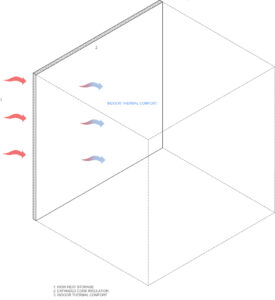
Its combination of low thermal conductivity, relatively high heat-storage capacity and vapor permeability can reduce conductive heat gains and help delay summer heat transfer through roofs and façades, improving indoor thermal comfort during heatwaves.
Image
Please download the PDF to have the information sent directly to your email address.
Healthcare Waste Insulation
Send download link to:
Implementation Guide
- Define the required thermal performance and insulation thickness
- Select board density and format according to the wall, roof or floor application
- Install continuously to minimize gaps and thermal bridges
- Protect the cork from prolonged direct weather and bulk-water exposure
- Coordinate vapor permeability and moisture management with the complete envelope assembly
- Combine with shading or ventilated façades/roofs where greater summer performance is required
Benefits and Limitations
Benefits
- Provides good thermal insulation and summer thermal damping
- Bio-based and renewable material with low-carbon potential
- Vapor permeable and moisture tolerant when correctly detailed
- Good acoustic performance
- Long service life with low maintenance requirements
Limitations
- Higher initial cost than some conventional insulation products
- Greater thickness may be required than with very high-performance insulation
- Availability depends on regional cork supply
- Requires protection from prolonged direct weather exposure
- Performance depends on the complete construction assembly, not only the insulation material
Parameter and data
Design Continuous thermal-insulation layer designed according to the required U-value, summer thermal performance and moisture behaviour of the complete envelope assembly
Particular attention should be given to insulation continuity at junctions, slab edges, window reveals and structural penetrations
Materials and Components
- Expanded cork granules
- Naturally bonded cork boards
- Mechanical fixings or compatible adhesives where required
- Protective render, cladding or lining depending on application
Application External wall insulation, ventilated façades, roofs, floors, cavity walls and retrofit insulation systems
Technical Properties
- Thermal conductivity: Approximately 0.038–0.040 W/m·K, specific values should be verified for the selected product
- Key properties include: Thermal insulation, heat-storage capacity, vapor permeability, moisture tolerance, acoustic insulation and dimensional stability
Thermal / Cooling Performance Reduces conductive heat transfer through roofs and façades and can contribute to delaying and damping summer heat gains
Heatwave performance depends on insulation thickness, density, thermal continuity and the characteristics of the complete building-envelope assembly
Operation Passive, no operational energy input is required
Advantages Combines thermal insulation, summer thermal damping, vapor permeability and bio-based content within a durable and relatively low-maintenance material
Applicability Criteria Suitable for roofs, façades and other envelope elements where bio-based insulation, vapor permeability and summer thermal performance are priorities
Particularly appropriate for projects where sufficient construction thickness is available. Protective layers should be provided where the material could be exposed to prolonged water or weathering
Expected Service Life 50+ years when properly installed, kept protected from prolonged moisture exposure and integrated within a durable envelope system
Please download the PDF to have the information sent directly to your email address.
Healthcare Waste Insulation
Send download link to:





