
Description
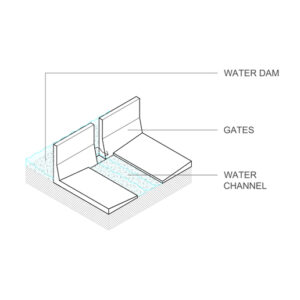
Flood diversion channels are engineered or naturalised waterways designed to redirect excess floodwater away from vulnerable buildings, sites or urban areas. Water is intercepted from a watercourse or drainage system, conveyed through a defined route and safely discharged downstream or into a suitable storage or receiving area.
Their effectiveness depends on adequate hydraulic capacity, stable channel geometry, erosion protection and a receiving system capable of accepting the diverted flow without increasing flood risk elsewhere.
Image
Please download the PDF to have the information sent directly to your email address.
Healthcare Waste Insulation
Send download link to:
Implementation Guide
- Assess design flood flows, water levels, velocities and downstream receiving conditions through hydraulic modelling
- Define a safe diversion alignment considering topography, available space, buildings, roads and utilities
- Size the intake, channel and outlet for the expected flows with appropriate freeboard
- Select channel geometry and lining according to hydraulic capacity, erosion risk and site conditions
- Protect vulnerable areas, inlets and outlets against scour and erosion
- Verify that diverted flows do not increase flood risk downstream or on adjacent sites
Benefits and Limitations
Benefits
- Provides high floodwater conveyance capacity
- Can significantly reduce flood levels in vulnerable areas
- Protects relatively large sites or groups of buildings
- Operates passively once constructed
Limitations
- Requires significant land and a continuous diversion route
- Usually involves high initial construction costs
- Can transfer or increase flood risk downstream if poorly designed
- May alter natural drainage, sediment transport and habitats
- Erosion, sediment and debris can reduce hydraulic capacity over time
Parameter and data
Design: Channel sized according to the design flood discharge through hydraulic modelling, with adequate cross-section, slope, freeboard, erosion protection and a safe receiving or discharge route
Materials and Components:
- Compacted earth
- Vegetation
- Riprap or stone protection
- Gabions
- Concrete or other channel lining where required
- Intake and diversion structures
- Outlet and energy-dissipation structures
- Erosion and scour protection
Advantages: High conveyance capacity and passive operation, providing effective large-area flood protection where a safe diversion and discharge route is available
Maintenance: Medium: periodic removal of debris and sediment, vegetation management, inspection of erosion and scour, and structural checks of intake, outlet and protection elements, particularly after major flood events
Environmental Impact: Medium–High: excavation and channel construction can alter drainage patterns, sediment transport and habitats. Naturalised designs and appropriate erosion-control measures can reduce these impacts
Applicability Criteria: Suitable where sufficient land is available to create a continuous diversion route and where diverted water can be discharged safely without increasing flood risk elsewhere. Less suitable in dense urban areas, constrained sites or locations without an adequate downstream receiving system
Expected Service Life: 50+ years for the main channel and permanent hydraulic structures, depending on construction type, erosion conditions and maintenance. Vegetation, erosion protection and individual structures may require earlier repair or renewal
Please download the PDF to have the information sent directly to your email address.
Healthcare Waste Insulation
Send download link to:





