Description
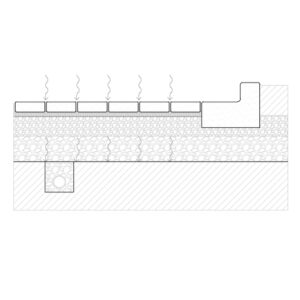
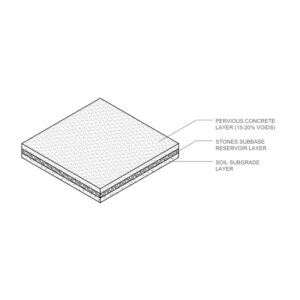
Pervious concrete is a porous pavement material with interconnected voids that allow stormwater to pass through the surface into an open-graded granular base and sub-base. The underlying layers can temporarily store water before infiltration into the ground or controlled discharge through a drainage system.
The measure reduces surface runoff and peak flows while providing a durable pavement for pedestrian and low-traffic areas.
Image
Please download the PDF to have the information sent directly to your email address.
Healthcare Waste Insulation
Send download link to:
Implementation Guide
- Assess runoff, subgrade permeability, groundwater conditions and expected traffic loads
- Design the pervious concrete layer and granular reservoir for both structural performance and stormwater storage
- Provide infiltration, an underdrain or controlled outlet according to site conditions
- Ensure adequate detailing at edges, joints and connections to conventional pavements
- Provide a safe overflow route for rainfall exceeding the design capacity
- Periodically clean the surface to maintain permeability and prevent clogging
Benefits and Limitations
Benefits
- Reduces surface runoff and peak stormwater flows
- Provides temporary water storage within the pavement system
- Can support infiltration where ground conditions allow
- Combines stormwater management with a usable paved surface
Limitations
- Hydraulic performance can decrease significantly through clogging
- Requires regular cleaning to maintain permeability
- Natural infiltration depends on subgrade and groundwater conditions
- Heavy-traffic applications require specific structural design
- Extreme rainfall can exceed the storage capacity of the pavement system
Parameter and data
Design: Monolithic pervious concrete pavement installed over an open-graded granular reservoir designed to provide structural support and temporary stormwater storage, with infiltration or controlled drainage according to site conditions
Materials and Components:
- Pervious concrete, typically with 15–25% interconnected voids
- Open-graded aggregate base and sub-base
- Optional geotextile depending on subgrade conditions
- Underdrain where required
- Edge restraints and drainage connections where necessary
Application: Pedestrian areas, sidewalks, plazas, parking areas and low-traffic roads integrated into Sustainable Drainage Systems (SuDS)
Thickness: Pervious concrete layer: typically 10–20 cm – Base/sub-base: typically 15–60+ cm, depending on structural loads and stormwater-storage requirements
Permeability: High, depending on concrete mix design, void content, installation quality and maintenance
Advantages: High permeability and temporary storage capacity, combining pavement use with stormwater attenuation, infiltration or controlled drainage
Maintenance: Medium: periodic vacuum cleaning and appropriate surface maintenance to prevent clogging, together with inspection of drainage and overflow systems where installed
Environmental Impact: Medium: cement content contributes to embodied carbon, while reduced runoff, temporary stormwater storage and potentially lower conventional drainage requirements can provide environmental benefits
Applicability Criteria: Suitable for pedestrian areas, parking and low-traffic surfaces where sufficient depth is available for a permeable pavement build-up. For infiltration systems, subgrade permeability and groundwater conditions must be suitable. On poorly permeable soils, an underdrain or controlled outlet may be required
Expected Service Life: 20–30 years, depending on concrete quality, structural loading, installation conditions and maintenance of surface permeability
Please download the PDF to have the information sent directly to your email address.
Healthcare Waste Insulation
Send download link to: