
Description
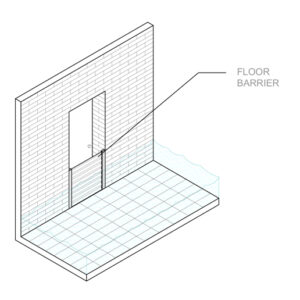
Flood-resistant doors are permanent door systems designed to limit water ingress through vulnerable building openings. They combine reinforced door leaves and frames, watertight seals, secure anchoring and compression-locking mechanisms capable of resisting the expected hydrostatic pressure.
Unlike temporary barriers, they remain integrated into the building and provide permanent protection for entrances, technical rooms and other critical spaces exposed to predictable flood depths.
Image
Please download the PDF to have the information sent directly to your email address.
Healthcare Waste Insulation
Send download link to:
Implementation Guide
- Determine the design flood level and select a tested door system suitable for the expected water depth and pressure
- Verify that surrounding walls, frames and anchors can resist the resulting flood loads
- Provide continuous watertight seals at the frame, threshold and wall interfaces
- Use secure compression or multi-point locking systems to maintain sealing pressure
- Ensure normal accessibility, operation and emergency-egress requirements are maintained
- Periodically test the door, seals and locking system, particularly after major flood events
Benefits and Limitations
Benefits
- Provides permanent protection without requiring temporary deployment
- Reduces water ingress through vulnerable entrances and critical openings
- Provides rapid and reliable operation during flood events
- Protects critical spaces and reduces post-flood damage and recovery time
Limitations
- Protects only the opening where the system is installed
- Requires structurally adequate walls, frames and anchoring
- Damaged seals, debris or incorrect closure can reduce watertight performance
- Higher cost than conventional doors or simple removable barriers
- Heavy doors, thresholds or locking systems may affect accessibility and everyday operation
Parameter and data
Design: Permanent door system tested for the design flood depth, with structural resistance to hydrostatic loads, continuous watertight sealing, secure anchoring and reliable compression locking
Materials and Components:
- Reinforced steel or aluminium door leaf and frame
- Structural core
- Compression seals and gaskets
- Watertight threshold
- Structural anchors
- Multi-point or compression locking system
- Sealants at frame-to-wall interfaces
Advantages: Permanent and rapidly deployable protection with no separate barrier storage, providing reliable protection for vulnerable openings and critical spaces
Maintenance: Low–Medium: periodic inspection and testing of seals, thresholds, hinges, locking mechanisms and frame fixings, with replacement of worn components when required
Environmental Impact: Low–Medium: higher material use than conventional or removable doors, partially offset by durability and reduced flood-related damage and replacement
Applicability Criteria: Suitable for entrances, technical rooms and critical spaces exposed to predictable flood depths where permanent protection is required. Most effective where the surrounding structure can safely resist flood loads and accessibility and emergency-egress requirements can be maintained
Expected service life: 20–30+ years for the main door and frame, depending on system quality, exposure and maintenance. Seals, gaskets and locking hardware may require earlier replacement
Please download the PDF to have the information sent directly to your email address.
Healthcare Waste Insulation
Send download link to:





