
Description
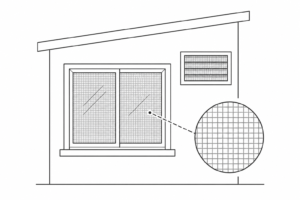
Fine non-combustible mesh screens are a simple retrofit measure that reduces the size and number of embers entering through ventilation openings, service grilles and small exterior apertures. They are most effective as part of a layered ember-resistance strategy.
The mesh must balance ember interception with airflow and maintenance, because very fine screens can clog rapidly.
Image
Please download the PDF to have the information sent directly to your email address.
Healthcare Waste Insulation
Send download link to:
Implementation Guide
- Identify unprotected external grilles and small openings
- Use corrosion-resistant metal mesh rather than combustible plastic screening
- Select mesh size based on airflow and available wildfire guidance
- Provide rigid support so screens do not deform
- Seal the screen perimeter to prevent bypass gaps
- Use removable frames for cleaning and replacement
- Inspect frequently during dusty or high-debris seasons
Benefits and Limitations
Benefits
- Low-cost and rapid retrofit
- Reduces penetration of larger embers
- Can complement existing vents
- Passive and energy-free
- Applicable to many small openings
Limitations
- Does not stop all small embers or hot gases
- Fine mesh can clog and reduce ventilation
- Unsealed edges can negate the benefit
- Metal mesh may corrode
- Should not be treated as equivalent to a purpose-designed ember-resistant vent
Parameter and data
Application: External vents, grilles and small openings where screening does not conflict with system function
Material: Stainless steel or other corrosion-resistant non-combustible metal mesh
Indicative Opening Size: External wildfire guidance often cites approximately 1.5-3 mm openings; treat this only as guidance, not a universal EU requirement
Airflow: Verify pressure drop and effective free area, especially at mechanical intakes/exhausts
Installation: Continuous perimeter fixing with no bypass gaps
Expected Service Life: Typically 10-25+ years depending on metal grade and exposure
Maintenance: Cleaning, corrosion inspection and checks for tears, deformation and edge gaps
Indicative Regulatory References: National ventilation requirements and wildfire guidance. Mesh-size recommendations are guidance-based rather than a single harmonised EU requirement
Please download the PDF to have the information sent directly to your email address.
Healthcare Waste Insulation
Send download link to:





