
Description
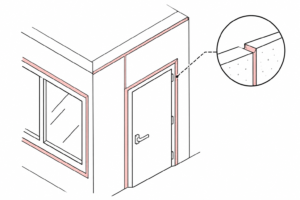
Sealing gaps and joints reduces hidden pathways through which embers can enter roof cavities, façades, soffits and service penetrations. Small discontinuities that are insignificant in normal weather can become important under wind-driven ember exposure.
The goal is to close unintended gaps while preserving designed ventilation, drainage and movement joints through protected details.
Image
Please download the PDF to have the information sent directly to your email address.
Healthcare Waste Insulation
Send download link to:
Implementation Guide
- Survey roof edges, eaves, soffits, façade joints, window perimeters and penetrations
- Close static gaps with metal flashings, mineral backing or compatible fire-resistant sealants
- Maintain movement capability at expansion joints using appropriate systems
- Protect designed ventilation openings rather than blocking required airflow
- Coordinate cavity closures with drainage and moisture management
- Reinspect after reroofing, façade or services work
- Prioritise gaps close to combustible substrates or ember accumulation zones
Benefits and Limitations
Benefits
- High potential benefit at relatively low cost
- Reduces concealed ember entry and hidden ignition
- Improves overall envelope robustness
- Suitable for new construction and retrofit
- Passive protection with low operational burden
Limitations
- A complete survey can be time-consuming
- Sealants age and require renewal
- Incorrect sealing can impair ventilation or drainage
- Very small discontinuities can be difficult to detect
- Does not address large unprotected openings
Parameter and data
Application: Roof, soffit, façade, window/door perimeter, service penetrations and movement joints
Materials: Metal flashings, mineral backing, fire-resistant sealants, gaskets and closure profiles
Gap Strategy: Eliminate unintended openings while preserving designed airflow and movement
Fire Stopping: Where part of a fire-resisting element, use a tested fire-stopping or linear-joint system
Expected Service Life: Metal closures 25-50+ years; sealants/gaskets commonly 10-25 years
Maintenance: Inspect after building works, movement, weather damage or sealant cracking
Indicative Regulatory References: EN 1366 series / EN 13501-2 where fire-stopping performance is required; national façade, roofing and fire regulations
Please download the PDF to have the information sent directly to your email address.
Healthcare Waste Insulation
Send download link to:





