
Description
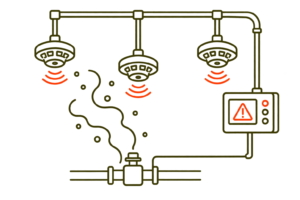
Gas detection systems monitor hazardous gases generated or released during fire, wildfire exposure or damage to building services. Depending on the application, the target may be combustible gas, carbon monoxide or another toxic or process gas.
As a wildfire-resilience measure this is conditional rather than universal and is most relevant where gas installations, enclosed parking or industrial processes create a credible secondary hazard.
Image
Please download the PDF to have the information sent directly to your email address.
Healthcare Waste Insulation
Send download link to:
Implementation Guide
- Define the target gas and credible release mechanism before selecting detectors
- Position sensors according to gas density, ventilation and likely release points
- Select technology with suitable range and selectivity
- Provide alarm thresholds and clear response actions
- Use protected standby power where the system is safety-critical
- Integrate shut-off or ventilation only after cause-and-effect verification
- Calibrate sensors and replace sensing elements as required
Benefits and Limitations
Benefits
- Provides warning of secondary gas hazards
- Can trigger ventilation or isolation automatically
- Useful in parking, plant and industrial areas
- Reduces risk of unnoticed toxic/flammable gas accumulation
- Can support post-fire re-entry assessment
Limitations
- Not necessary without a credible gas hazard
- Sensor life is limited
- Cross-sensitivity can affect accuracy
- Requires calibration and specialist maintenance
- Different gases require different detector types and locations
Parameter and data
Application: Garages, plant rooms, fuel installations and industrial processes
Target Gases: Combustible gases, carbon monoxide or process-specific gases defined by risk assessment
Sensor Types: Infrared, electrochemical, catalytic, semiconductor or other gas-specific technologies
Outputs: Local alarm, BMS/fire interface, ventilation, shut-off or emergency shutdown
Expected Service Life: Control equipment 10-15+ years; sensing cells commonly 2-10 years
Maintenance: Calibration, bump testing, sensor replacement and alarm/interlock tests
Indicative Regulatory References: Gas-specific standards and ATEX requirements where flammable atmospheres are relevant; national occupational and fire-safety regulations
Please download the PDF to have the information sent directly to your email address.
Healthcare Waste Insulation
Send download link to:





