
Description
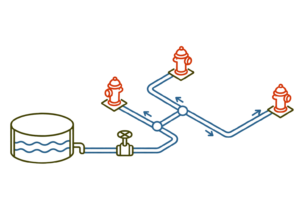
A fire-water supply network distributes firefighting water from public mains, storage tanks and pumps to hydrants, sprinklers, water monitors, hose systems and external spray systems. Wildfire resilience depends on the network remaining available despite local damage or utility disruption.
Looped mains, sectional isolation and protected routing can improve robustness on large sites.
Image
Please download the PDF to have the information sent directly to your email address.
Healthcare Waste Insulation
Send download link to:
Implementation Guide
- Determine simultaneous fire-water demands from systems that may operate together
- Hydraulically size mains, pumps and pressure zones for the most onerous credible condition
- Use ring/loop layouts and sectional valves where justified
- Protect exposed pipework, valve chambers and pump connections
- Separate critical fire reserve from non-fire water uses
- Provide test points, drains and pressure monitoring
- Maintain accurate site plans and valve identification
Benefits and Limitations
Benefits
- Determine simultaneous fire-water demands from systems that may operate together
- Hydraulically size mains, pumps and pressure zones for the most onerous credible condition
- Use ring/loop layouts and sectional valves where justified
- Protect exposed pipework, valve chambers and pump connections
- Separate critical fire reserve from non-fire water uses
- Provide test points, drains and pressure monitoring
- Maintain accurate site plans and valve identification
Limitations
- High excavation and installation cost
- Leaks or undocumented valves can impair performance
- Still depends on source and pump reliability
- Large sites require ongoing asset management
- Pressure surge and freeze risks may require additional controls
Parameter and data
Application: Campuses, industrial facilities and large sites with multiple water-based fire systems
Configuration: Dedicated main or ring main, sectional valves, pressure monitoring and test/drain points
Hydraulic Criteria: Pipe diameter and pump duty from calculated simultaneous demand and residual pressure
Materials: Ductile iron, steel, approved buried plastic or other fire-water pipe materials
Resilience: Looping, protected routing and redundancy of sources/pumps where justified
Expected Service Life: Buried mains typically 40-60+ years; valves/instrumentation require earlier renewal
Maintenance: Leak checks, valve exercise, flow/pressure testing, flushing and asset records
Indicative Regulatory References: EN 12845 where serving sprinklers; hydrant standards where applicable; national firefighting-water and pipe-network requirements
Please download the PDF to have the information sent directly to your email address.
Healthcare Waste Insulation
Send download link to:





