
Description
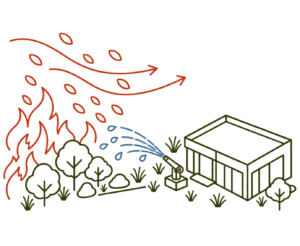
Water cannons, also called fire monitors, are high-capacity devices that project water or foam over long distances. They are suited to industrial, logistics and large external areas where rapid high-flow cooling or suppression is required and normal sprinkler or hose coverage is insufficient.
For wildfire exposure they can protect high-risk façades, roofs, tanks, storage yards or external equipment from a safer remote position.
Image
Please download the PDF to have the information sent directly to your email address.
Healthcare Waste Insulation
Send download link to:
Implementation Guide
- Use a fire-risk assessment to identify target hazards and required water/foam application
- Position monitors for unobstructed coverage while preserving evacuation and responder access
- Hydraulically design water supply, pumps and pipe network
- Choose fixed, oscillating, remote-controlled or manual monitors according to hazard
- Integrate automatic/remote operation with detection only where logic is robust
- Provide drainage and control of large water runoff
- Conduct periodic flow/throw testing and maintain nozzles, drives, valves and controls
Benefits and Limitations
Benefits
- High-volume suppression and cooling
- Long throw allows operation from safer positions
- Can protect façades, roofs, tanks and external plant
- Remote control can reduce responder exposure
- Foam-capable systems can address selected liquid-fuel hazards
Limitations
- Very high water and pump demand
- High capital and maintenance cost
- Wind can reduce throw and coverage
- Potential for significant water damage/runoff
- Not normally suitable as sole protection in occupied buildings
Parameter and data
Application: Industrial buildings, warehouses, logistics centres, ports, waste facilities and high fire-load external zones
System Types: Fixed, oscillating, manual or remote-controlled monitors; water or foam-water configurations
Indicative Flow: Hundreds to several thousand litres per minute depending on monitor and hazard; final design must be risk-based
Throw: Product- and condition-specific, strongly affected by nozzle, pressure, flow and wind
Activation: Manual, remote or automatic/semi-automatic where supported by detection
Expected Service Life: Approximately 20-30+ years with regular maintenance
Maintenance: Flow testing, nozzle cleaning, valve/pump tests, corrosion checks and control-system testing
Indicative Regulatory References: National industrial fire-safety requirements; EN 13565 series where foam systems are used; relevant water-supply/pump standards and manufacturer documentation
Please download the PDF to have the information sent directly to your email address.
Healthcare Waste Insulation
Send download link to:





