
Description
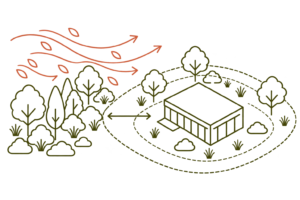
Defensible space is the managed area surrounding a building where vegetation, stored materials and other combustible fuels are reduced, separated or arranged to lower flame intensity, radiant heat and ember accumulation near the structure.
The appropriate width and treatment depend on vegetation, slope, wind, climate, building vulnerability and regional wildfire requirements; a single universal distance should not be applied across Europe.
Image
Please download the PDF to have the information sent directly to your email address.
Healthcare Waste Insulation
Send download link to:
Implementation Guide
- Assess vegetation, topography, wind exposure and likely wildfire approach directions
- Create a near-building zone with minimal combustible material and progressively manage fuel farther away
- Separate dense shrubs and tree crowns to reduce continuous flame paths
- Remove ladder fuels that allow surface fire to climb into canopies
- Relocate firewood, bins, furniture and fuel stores away from vulnerable façade/opening zones
- Maintain fire-service access around critical elevations
- Review and maintain the space seasonally
Benefits and Limitations
Benefits
- Reduces flame intensity and radiant heat near the building
- Reduces ember-catching fuels at the structure edge
- Improves firefighter access and working conditions
- Can reduce risk without altering the main building
- Supports other envelope hardening measures
Limitations
- Requires site area and control of surrounding land
- Needs recurring vegetation management
- Effectiveness varies with extreme weather and slope
- Neighbouring unmanaged land remains an exposure source
- Landscape objectives may conflict with fuel reduction
Parameter and data
Application: Buildings and campuses at the wildland-urban interface or near combustible vegetation
Treatment Zones: Use project-specific near, intermediate and extended management zones rather than a universal distance
Fuel Management: Remove dead fuels, separate vegetation, limit ladder fuels and relocate combustible storage
Site Interfaces: Coordinate with access roads, hydrants, drainage and ecological constraints
Expected Service Life: Continuous management measure rather than a one-time installation
Maintenance: Seasonal mowing/pruning, dead-fuel removal, irrigation management and storage control
Indicative Regulatory References: Regional/national wildfire and landscape-management guidance; local fire-service requirements. No single harmonised EU defensible-space distance applies universally
Please download the PDF to have the information sent directly to your email address.
Healthcare Waste Insulation
Send download link to:





