
Description
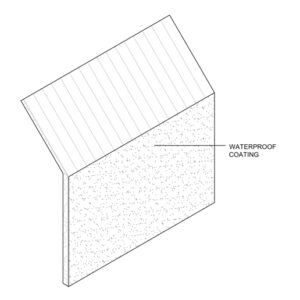
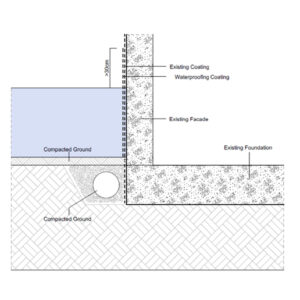
Cementitious waterproof coatings are mineral-based surface treatments applied to façades and other concrete or masonry substrates to reduce water penetration. The coating forms a continuous bonded layer while generally maintaining vapour permeability.
For flood resilience, these systems are particularly suitable for stable mineral surfaces exposed to temporary or moderate water pressure and should be complemented by appropriate detailing at cracks, joints, openings and penetrations.
Image
Please download the PDF to have the information sent directly to your email address.
Healthcare Waste Insulation
Send download link to:
Implementation Guide
- Assess the expected flood exposure and condition of the façade substrate
- Repair cracks, defects and irregularities and thoroughly prepare the surface
- Select a cementitious waterproof coating compatible with the substrate and expected movement
- Apply the required continuous layers and reinforce critical joints or transitions where necessary
- Seal openings, penetrations and wall–floor connections with compatible waterproofing details
- Inspect the completed coating and repair any discontinuities or damage
Benefits and Limitations
Benefits
- Reduces water penetration through porous mineral façades
- Provides good adhesion to concrete and masonry substrates
- Maintains relatively good vapour permeability
- Provides a durable and relatively cost-effective retrofit solution
Limitations
- Limited capacity to accommodate significant cracking or substrate movement
- Does not provide structural resistance against hydrostatic flood loads
- Performance depends strongly on substrate preparation and application quality
- Joints, penetrations and major cracks require complementary waterproofing
- Not suitable as the sole protection for high-pressure or prolonged flooding
Parameter and data
Design: Continuous surface-applied cementitious waterproof layer bonded to the mineral substrate, with flexible polymer modification where required to accommodate limited movement and microcracking
Materials and Components:
- Cement-based binders
- Mineral fillers
- Polymer modifiers for flexible systems
- Water
- Compatible primers or bonding agents where required
- Reinforcement mesh at critical areas where necessary
- Joint and penetration sealants
Application: Façades, plinths, concrete or masonry walls, retaining walls and other mineral surfaces exposed to temporary water contact or moderate flood conditions
Thickness: Typically 1.5–3 mm, depending on the selected system and manufacturer requirements
Permeability: Low liquid-water permeability with generally moderate to high vapour permeability, depending on product formulation and application thickness
Advantages: Good adhesion to mineral substrates, relatively breathable construction, simple application and effective protection against moderate water exposure
Maintenance: Low: periodic inspection for cracking, detachment or local damage, with localized repair where necessary
Environmental Impact: Low–Medium: predominantly mineral-based materials generally have lower impacts than polymer-rich membrane systems, although cement content contributes to embodied carbon
Applicability Criteria: Suitable for stable concrete, masonry and other mineral substrates with limited movement and moderate floodwater exposure. Not suitable as the sole protection for structurally damaged walls, significant cracking or high hydrostatic pressures without complementary structural and waterproofing measures
Expected Service Life: 20–30 years, depending on substrate condition, exposure, product quality and application. Local repairs may be required earlier at cracks, joints or damaged areas
Please download the PDF to have the information sent directly to your email address.
Healthcare Waste Insulation
Send download link to:





