
Description
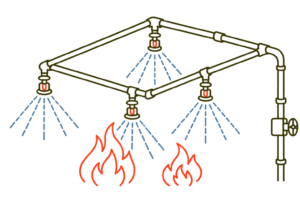
An internal automatic sprinkler system detects heat at individual sprinkler heads and discharges water locally to control or suppress a developing fire. In wildfire-prone buildings it can control internal fires initiated by ember entry, glazing failure or spread through openings.
The system is most effective when supported by reliable water storage, pumps, monitored valves and maintenance.
Image
Please download the PDF to have the information sent directly to your email address.
Healthcare Waste Insulation
Send download link to:
Implementation Guide
- Classify the internal fire hazard and select the applicable design density/area of operation
- Hydraulically calculate pipework, sprinklers, pumps and water supply
- Use sprinkler types and temperature ratings suitable for occupancy and ceiling conditions
- Protect pipework against freezing, impact and corrosion
- Monitor control valves, flow and pump status
- Coordinate storage layouts so discharge patterns remain effective
- Inspect, test and maintain the complete system including water supply and alarms
Benefits and Limitations
Benefits
- Automatically controls many developing internal fires
- Operates locally at the fire
- Can reduce fire growth and property loss
- Provides protection when the building is unoccupied
- Complements compartmentation and detection
Limitations
- Does not stop the external wildfire front
- High installation cost and water demand
- Requires reliable water supply and often pumps
- Obstructions or storage changes can reduce performance
- Freeze and corrosion risks require design controls
Parameter and data
Application: Residential, commercial, public, industrial and storage buildings according to risk and regulation
Design Basis: Hazard classification, design density, area of operation and hydraulic calculation
Components: Sprinkler heads, pipes, valves, alarm devices, pumps, tanks/mains connection and monitoring
Activation: Individual heat-responsive sprinklers operate when local temperature reaches their rated threshold
Water Supply: Public main, tank/pump or combined supply sized for required flow and duration
Expected Service Life: Pipework often 30-50+ years; valves, pumps and heads require periodic testing/replacement
Maintenance: Inspections, valve checks, alarm tests, flow tests, pump tests and servicing
Indicative Regulatory References: EN 12845 where applicable; EN 12259 series for components; national fire-safety requirements
Please download the PDF to have the information sent directly to your email address.
Healthcare Waste Insulation
Send download link to:





