
Description
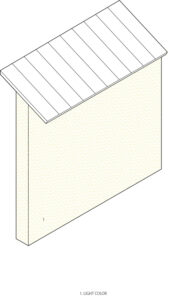
Light-colored exterior finishes use paints, renders, claddings or surface treatments with relatively high solar reflectance to reduce the amount of solar radiation absorbed by façades and external surfaces.
By keeping exposed surfaces cooler, they can reduce heat transfer into buildings and limit heat re-radiation to surrounding outdoor spaces, providing a simple passive adaptation measure for heatwave conditions.
Image
Please download the PDF to have the information sent directly to your email address.
Healthcare Waste Insulation
Send download link to:
Implementation Guide
- Identify dark surfaces with high solar exposure and overheating impact
- Select durable finishes with high solar reflectance and suitable thermal emissivity
- Prepare substrates by cleaning and repairing cracks or defects
- Select compatible paints, renders or cladding according to the existing construction
- Avoid excessive glare toward neighbouring buildings or public spaces
- Maintain reflectance through periodic cleaning and recoating where necessary
Benefits and Limitations
Benefits
- Reduces solar absorption and exterior surface temperatures
- Low-cost and easy to implement in retrofit projects
- Can reduce heat transfer through exposed façades
- Adds minimal weight and structural impact
- Can contribute to reducing local heat accumulation
Limitations
- Performance decreases as surfaces become dirty or weathered
- Very bright or glossy finishes can cause glare
- Cooling impact is lower than insulation or external shading
- Heritage or urban-design requirements may restrict colour selection
- Effectiveness depends on solar exposure and surface reflectance
Parameter and data
Design Exterior finish selected primarily according to solar reflectance, durability, substrate compatibility and visual requirements
Light colour can be used as a practical strategy, but actual solar reflectance should be considered where product data are available
Materials and Components
- High-reflectance paints
- Silicate paints
- Acrylic or silicone coatings
- Mineral or lime renders
- Light-coloured ceramic tiles
- Reflective pigments
- Light-coloured cladding and paving materials
Application Façades, external walls, courtyard surfaces, parapets, balconies, roofs, urban furniture and external hardscape surfaces
Technical Properties
- Solar reflectance / albedo
- Thermal emissivity
- Surface colour
- Weather resistance
- UV resistance
- Substrate compatibility
Specific values depend on the selected product
Thermal / Cooling Performance Reduces solar heat absorption and exposed surface temperatures, helping to limit heat transfer through external walls and other building elements
Actual performance depends on solar exposure, reflectance, emissivity, insulation level and the complete construction assembly
Operation Passive, no operational energy input is required
Advantages Simple, lightweight and low-cost measure that can be applied rapidly to existing buildings and combined easily with insulation, shading or ventilated façade strategies
Applicability Criteria Suitable for highly solar-exposed façades and exterior surfaces where increased solar reflectance can reduce heat absorption
Glare, architectural appearance, heritage requirements and compatibility with existing substrates should be assessed before application
Expected Service Life Paints and coatings: Approximately 8–15 years
Mineral renders: Approximately 20–40 years
Please download the PDF to have the information sent directly to your email address.
Healthcare Waste Insulation
Send download link to:





