Description
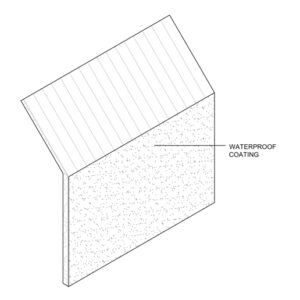
Liquid-applied polyurethane membranes form a continuous, elastic and joint-free waterproof layer bonded to the façade substrate. Their flexibility allows them to accommodate minor movements and cracking while reducing water ingress through porous surfaces and complex junctions.
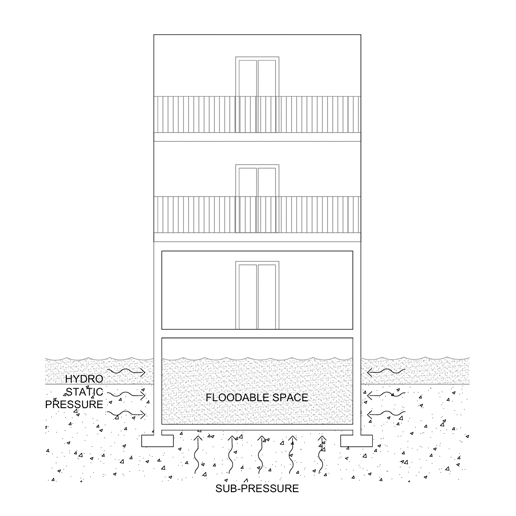
For flood resilience, the selected system must be suitable for the expected water exposure and used together with appropriate detailing at openings, joints and penetrations. The membrane does not provide structural resistance against hydrostatic loads.
Image
Please download the PDF to have the information sent directly to your email address.
Healthcare Waste Insulation
Send download link to:
Implementation Guide
- Assess the design flood level, expected water pressure and condition of the façade substrate
- Repair cracks and defects and prepare the surface before application
- Select a polyurethane membrane suitable for the expected water exposure and substrate movement
- Apply primer, membrane and reinforcement at critical joints or transitions where required
- Ensure continuous sealing around openings, penetrations and wall–floor connections
- Provide UV or mechanical protection where required and inspect the completed waterproofing system
Benefits and Limitations
Benefits
- Provides continuous waterproof protection with no membrane joints
- Accommodates minor substrate movements and cracking
- Adapts easily to complex geometries, connections and retrofit conditions
- Reduces water ingress and moisture-related deterioration of the building envelope
Limitations
- Does not provide structural resistance against hydrostatic flood loads
- Performance depends strongly on substrate preparation and application quality
- Damage, discontinuities or poorly sealed penetrations can compromise watertightness
- Some systems may require protective coatings or periodic recoating, particularly when UV-exposed
- Suitability for prolonged immersion or significant water pressure must be verified for the selected product
Parameter and data
Design: Continuous liquid-applied elastic membrane bonded to the substrate, with reinforced detailing at critical joints, penetrations and transitions where required. The selected system should be compatible with the expected flood exposure and substrate movement
Materials and Components:
- Polyurethane waterproofing membrane
- Compatible primer
- Reinforcement mesh or fabric where required
- Joint and penetration sealants
- Protective or UV-resistant topcoat where required
Application: Façades, plinths, retaining walls and complex junctions exposed to water ingress, particularly in retrofit applications and substrates with limited movement or cracking risk
Thickness: Typically 1.2–2.5 mm, depending on the selected waterproofing system and manufacturer requirements
Permeability: Typically 1.2–2.5 mm, depending on the selected waterproofing system and manufacturer requirements
Advantages: Seamless, elastic and adaptable waterproofing suitable for complex geometries and substrates subject to minor movement
Maintenance: Medium: periodic inspection for cracking, detachment, punctures and deterioration, with localized repairs or recoating where required, particularly on exposed surfaces
Environmental Impact: Medium: polyurethane is a polymer-based material with relatively high embodied impacts and limited recyclability, although its durability and ability to reduce water-related damage can reduce replacement requirements
Applicability Criteria: Suitable for sound façade substrates requiring continuous waterproofing and some accommodation of minor movement. Not suitable as the sole protection for structurally damaged walls, major cracks or high hydrostatic pressures unless the complete system has been specifically designed and tested for those conditions
Expected Service Life: 20–25 years, depending on product quality, substrate condition, UV exposure, protective layers and maintenance. Local repairs or recoating may be required earlier
Please download the PDF to have the information sent directly to your email address.
Healthcare Waste Insulation
Send download link to: