
Description
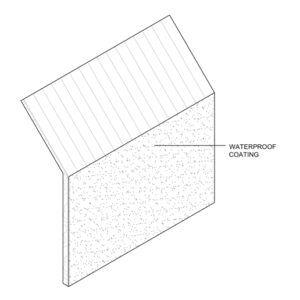
Hydrophobic impregnation is a penetrating water-repellent treatment applied to porous mineral façades. Silane- or siloxane-based products penetrate the substrate and reduce capillary water absorption without forming a continuous surface film, allowing water vapour diffusion.
The measure can reduce moisture-related deterioration and short-term water absorption but does not provide a watertight barrier against hydrostatic pressure or prolonged flooding.
Image
Please download the PDF to have the information sent directly to your email address.
Healthcare Waste Insulation
Send download link to:
Implementation Guide
- Assess substrate porosity, condition and expected water exposure
- Repair cracks and defects before treatment and clean the surface thoroughly
- Select a compatible silane- or siloxane-based product and test it on the substrate where appropriate
- Apply uniformly according to the required absorption and coverage
- Maintain separate waterproof detailing at joints, openings and penetrations
- Inspect performance periodically and reapply the treatment when water repellency decreases
Benefits and Limitations
Benefits
- Reduces capillary water absorption and moisture-related deterioration
- Maintains high vapour permeability of mineral substrates
- Provides an invisible treatment with minimal visual impact
- Requires limited material and intervention
Limitations
- Does not provide protection against hydrostatic pressure or prolonged immersion
- Does not seal cracks, joints or structural defects
- Performance depends strongly on substrate porosity and condition
- Requires periodic reapplication to maintain effectiveness
Parameter and data
Design: Penetrating, non-film-forming hydrophobic treatment that reduces capillary water absorption while maintaining vapour diffusion through the mineral substrate
Materials and Components:
- Silane-based impregnation
- Siloxane-based impregnation
- Water-based or solvent-based carriers
- Compatible surface-preparation products where required
Application: Porous mineral façades, exposed concrete, brickwork and natural stone, including appropriate heritage substrates after compatibility assessment
Thickness: N/A – the treatment penetrates into the porous substrate rather than forming a defined surface layer
Permeability: Very low capillary water absorption after treatment, while maintaining high vapour permeability. Performance depends on the product and substrate
Advantages: Invisible and breathable protection with easy application and minimal alteration of the existing façade
Maintenance Medium: periodic inspection of water-repellent performance and local repair or reapplication, typically after approximately 5–10 years depending on exposure and product performance
Environmental Impact: Low: limited material use and minimal intervention, particularly for water-based systems. Periodic reapplication should be considered in the lifecycle assessment
Applicability Criteria: Suitable for sound, porous mineral substrates exposed to rain, splash water or limited floodwater contact. Not suitable as the sole protection for cracked or structurally damaged façades, non-porous substrates, prolonged immersion or significant hydrostatic pressure
Expected Service Life: 5–10 years of effective water-repellent performance, depending on product, substrate, exposure and application quality. Periodic reapplication may be required
Please download the PDF to have the information sent directly to your email address.
Healthcare Waste Insulation
Send download link to:





