
Description
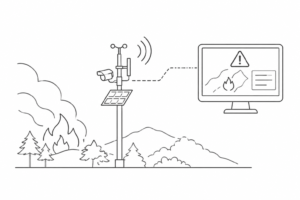
A wildfire early warning system provides building operators and occupants with actionable information that a wildfire may threaten the site. It may receive official civil-protection alerts, wildfire agency information, local weather data, site sensors or camera-based information.
The key function is early decision support: when to prepare the building, stop external activities, protect critical operations and evacuate before roads or external areas become unsafe.
Image
Please download the PDF to have the information sent directly to your email address.
Healthcare Waste Insulation
Send download link to:
Implementation Guide
- Use official civil-protection and wildfire authority alerts as the primary external warning source where available
- Define warning levels and corresponding actions in the wildfire emergency plan
- Integrate warnings with BMS, public-address/voice alarm, SMS/app or control-room procedures where justified
- Provide resilient communications and backup power
- Treat local sensors or cameras as supplementary and include false-alarm verification
- Maintain contact lists, escalation procedures and manual override
- Test the end-to-end warning-to-action process through drills
Benefits and Limitations
Benefits
- Increases time available for evacuation and protective actions
- Allows action before smoke or flames directly affect the site
- Coordinates building, landscape and operational measures
- Supports orderly shutdown of vulnerable equipment
- Improves communication with staff and occupants
Limitations
- Lead time depends on external data quality
- Communications may be congested or damaged
- Local sensors can generate false alarms
- Requires trained decision makers and clear procedures
- Warning does not guarantee safe evacuation if roads are already compromised
Parameter and data
Application: Buildings, campuses, industrial sites, schools, healthcare facilities and remote assets
Inputs: Official alerts, wildfire agency information, weather data and local cameras/sensors
Outputs: Control-room alarm, PA/voice alarm, SMS/app, BMS actions and emergency-procedure activation
Resilience: Backup power, redundant communications where justified and manual fallback procedures
Response Logic: Predefined stages such as awareness, preparation and evacuation according to instructions from the competent authorities
Expected Service Life: Electronics typically 10-15 years; software and communications interfaces need periodic updates
Maintenance: Communication tests, software updates, battery checks, sensor cleaning/calibration and drills
Indicative Regulatory References: National/regional civil-protection and wildfire-warning frameworks; EN 54-16 / EN 54-24 where voice alarm equipment is integrated; telecommunications requirements as applicable
Please download the PDF to have the information sent directly to your email address.
Healthcare Waste Insulation
Send download link to:





