
Description
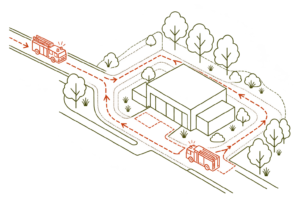
Emergency vehicle access routes are all-weather site roads, gates, turning areas and hardstanding that allow fire-service vehicles to reach and operate near the building. Wildfires can rapidly reduce access through smoke, congestion, vegetation, fallen branches or damaged infrastructure.
Route geometry should be coordinated with local fire-service vehicle dimensions and operational tactics rather than generic values.
Image
Please download the PDF to have the information sent directly to your email address.
Healthcare Waste Insulation
Send download link to:
Implementation Guide
- Consult the competent fire service for required width, height, gradient, turning radius and load capacity
- Provide all-weather surfacing and drainage suitable for heavy vehicles
- Keep gates and barriers capable of rapid emergency release
- Maintain clear vertical and horizontal envelopes free of trees, vehicles and storage
- Provide turning heads or loops where long reversing would be unsafe
- Coordinate access with hydrants, fire-water connections and staging areas
- Inspect after storms and during wildfire season for vegetation encroachment and obstruction
Benefits and Limitations
Benefits
- Improves speed and safety of firefighter intervention
- Supports hose deployment and hydrant access
- Reduces delay caused by narrow or obstructed private roads
- Can improve overall site resilience
- Supports emergency logistics
Limitations
- Requires significant site area
- Retrofit may be impossible on constrained sites
- Roads can still be cut off by wildfire
- Vegetation clearance is ongoing
- Dimensions vary by local fire-service fleet and regulation
Parameter and data
Application: Campuses, industrial sites, remote buildings and large plots
Geometry: Width, turning radius, gradient and clearance defined by local fire-service/national requirements
Pavement: All-weather, drained surface with adequate axle/load capacity
Access Control: Emergency override for gates/bollards and clear signage/address identification
Vegetation Clearance: Maintain clear route envelope and reduce overhanging branches/roadside fuel
Expected Service Life: Road/pavement typically 20-40+ years with resurfacing
Maintenance: Surface repair, drainage cleaning, vegetation cutting, gate testing and obstruction control
Indicative Regulatory References: National/local fire-service access requirements and road/structural standards; site wildfire emergency plan
Please download the PDF to have the information sent directly to your email address.
Healthcare Waste Insulation
Send download link to:





