
Description
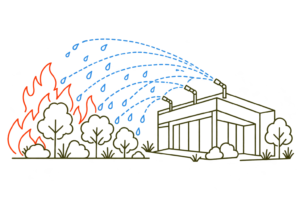
An external water-spray system uses engineered nozzles to wet or cool selected roofs, façades, openings or equipment exposed to wildfire heat and embers. It is distinct from an internal sprinkler system: its purpose is exposure protection and suppression of small external ignitions.
Wind can strongly affect spray distribution, so the system should be engineered for specific target surfaces and should not justify otherwise combustible construction.
Image
Please download the PDF to have the information sent directly to your email address.
Healthcare Waste Insulation
Send download link to:
Implementation Guide
- Define exact target surfaces from a wildfire risk assessment
- Design nozzle type, spacing, flow and pressure considering wind and geometry
- Provide reliable independent water reserve where public supply may fail
- Protect nozzles and pipes from blockage, freezing, impact and vegetation
- Use remote/automatic activation only with clear cause-and-effect logic and manual override
- Provide drainage so spray flows do not cause water ingress
- Conduct wet tests to verify actual coverage
Benefits and Limitations
Benefits
- Can cool exposed surfaces and reduce radiant heat loading
- Can extinguish small ember ignitions on targeted surfaces
- Provides remote protection where manual access is unsafe
- Can protect critical external equipment and openings
- Complements passive wildfire hardening
Limitations
- High water demand and infrastructure cost
- Wind can reduce coverage
- Nozzles may clog or be damaged
- Requires frequent testing and maintenance
- Should not replace passive envelope hardening
Parameter and data
Application: Targeted roofs, façades, glazing zones and external equipment identified by risk assessment
System Types: Open-nozzle deluge/water spray, directional spray bars or specialised exposure-protection systems
Hydraulic Design: Project-specific flow, pressure and distribution verified by hydraulic calculation and wet testing
Activation: Manual, remote or automatic according to the risk strategy
Water Supply: Dedicated tank/pumps or other reliable source sized for flow and duration
Expected Service Life: Pipework 20-40+ years; nozzles, valves, pumps and controls need servicing
Maintenance: Nozzle cleaning, wet coverage tests, valve/pump testing and corrosion/freeze checks
Indicative Regulatory References: Project-specific fire engineering; EN 12845 / EN 12259 only where relevant to integrated water-based systems; national fire-service and insurer criteria. No single harmonised EU wildfire spray standard applies universally
Please download the PDF to have the information sent directly to your email address.
Healthcare Waste Insulation
Send download link to:





