
Description
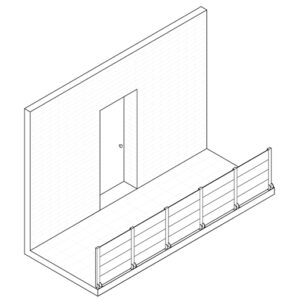
This measure consists of installing permanent localized barriers or enclosures around critical equipment and services to protect them from floodwater when elevation or relocation is not feasible. These barriers act as mini-perimeter protections, isolating individual elements (e.g., boilers, generators and electrical panels) from water ingress. They must be designed to resist hydrostatic pressure, ensure watertightness, and, if necessary, incorporate drainage or pumping systems. This solution is particularly useful in retrofit scenarios or where only specific equipment requires protection.
Image
Please download the PDF to have the information sent directly to your email address.
Healthcare Waste Insulation
Send download link to:
Implementation Guide
- Identify critical equipment that cannot be elevated or relocated and determine the design flood conditions
- Design the barrier above the design flood level with an appropriate safety margin and verify structural resistance to flood loads
- Ensure continuous watertightness at walls, floors, joints and service penetrations
- Provide watertight access doors or removable sections where maintenance access is required
- Ensure that ventilation, combustion-air, exhaust and cooling requirements remain functional
- Provide secondary drainage or pumping where residual leakage may occur
- Inspect and test the enclosure and access systems after installation and major flood events
Benefits and Limitations
Benefits
- Provides reliable protection for specific critical equipment
- Suitable where elevation or relocation is not feasible
- More targeted and generally less costly than protecting the entire building
- Reduces equipment damage, downtime and post-flood replacement
Limitations
- Protects only the equipment enclosed by the barrier
- Requires careful structural design and continuous watertight detailing
- Service penetrations and access openings can create vulnerable points
- May interfere with equipment access, ventilation or operation if poorly designed
- Higher flood depths or dynamic loads can significantly increase structural complexity and cost
Parameter and data
Design: Localized watertight enclosure extending above the design flood level with an appropriate safety margin; structural resistance to hydrostatic and other relevant flood loads; watertight joints, service penetrations and access openings
Materials and Components:
- Reinforced concrete or masonry
- Waterproof membranes or coatings
- Sealants and waterstops
- Watertight doors or access panels
- Sealed service penetrations
- Structural anchoring systems
- Drainage and sump pumps where required
Advantages: Targeted, permanent and retrofit-friendly protection that reduces flood exposure of critical equipment without requiring full-building floodproofing
Maintenance: Medium: periodic inspection of joints, seals, penetrations and access doors, with testing and maintenance of drainage or pumping systems where installed
Environmental Impact: Low–Medium: localized construction limits material use compared with full perimeter protection, although concrete, waterproofing systems and additional equipment create embodied impacts
Applicability Criteria: Suitable for critical equipment located within flood-prone areas when elevation or relocation is technically or spatially impractical. Not suitable where equipment ventilation, access or operation cannot be maintained, or where flood loads exceed the practical capacity of a localized enclosure
Expected service life: 30–60 years for the permanent structural barrier, depending on materials, exposure and maintenance. Seals, waterproofing components, access systems and pumps may require earlier replacement
Please download the PDF to have the information sent directly to your email address.
Healthcare Waste Insulation
Send download link to:





