
Description
Self-healing coatings are protective surface treatments designed to autonomously repair minor damage such as microcracks or scratches, helping restore coating continuity and reduce water ingress.
Healing mechanisms may include encapsulated agents or reversible polymer systems activated by damage, moisture or other environmental conditions. They can improve durability in flood-prone areas exposed to repeated wetting and minor surface deterioration.
Image
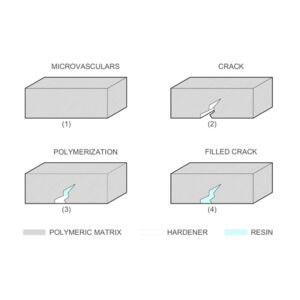
Please download the PDF to have the information sent directly to your email address.
Healthcare Waste Insulation
Send download link to:
Implementation Guide
- Assess the substrate, expected water exposure and type of surface damage
- Select a self-healing coating compatible with the substrate and exposure conditions
- Prepare and repair the substrate before application
- Apply the coating according to the required thickness and curing conditions
- Protect critical joints and penetrations with complementary waterproofing where necessary
- Inspect performance after flooding and repair major damage that exceeds the coating’s self-healing capacity
Benefits and Limitations
Benefits
- Can autonomously repair minor coating damage
- Helps maintain water resistance and surface durability
- Reduces localized repairs and recoating interventions
- Can extend the service life of protected surfaces
Limitations
- Self-healing capacity is generally limited to minor cracks or surface damage
- Performance varies significantly according to the coating technology and environmental conditions
- Does not repair structural cracks or major substrate damage
- Higher initial cost than conventional protective coatings
Parameter and data
Design: Protective coating system incorporating self-healing mechanisms capable of restoring continuity after minor surface damage
Materials and Components: Depending on the selected technology:
- Polyurethane, epoxy or acrylic matrices
- Encapsulated healing agents
- Reversible or responsive polymers
- UV- and chemical-resistance additives
- Compatible primers and protective layers
Application: Walls, plinths, façades, concrete surfaces and other flood-prone elements subject to repeated wetting and minor surface damage
Thickness: Typically 0.5–2 mm, depending on the selected coating system
Permeability: Generally low water permeability, while vapour permeability varies according to the coating formulation and product
Advantages: Self-healing of minor damage, improved coating durability, reduced repair needs and enhanced resistance to repeated water exposure
Maintenance: Low: periodic visual inspection, with localized repair or recoating only where damage exceeds the self-healing capacity of the system
Environmental Impact: Medium: advanced polymers and healing agents increase material complexity, but improved durability and reduced repair frequency may lower lifecycle maintenance and replacement impacts
Applicability Criteria: Suitable for surfaces exposed to repeated wetting and minor cracking or coating damage. Not suitable as the sole protection against structural cracking, major substrate deterioration or high hydrostatic pressure unless specifically designed and tested for those conditions
Expected service life: 20–30 years, depending on coating technology, substrate condition, environmental exposure and maintenance
Please download the PDF to have the information sent directly to your email address.
Healthcare Waste Insulation
Send download link to:





