
Description
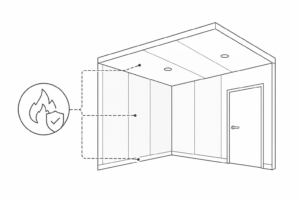
Fire-resistant internal finishes are wall, ceiling, floor and coating systems selected to limit flame spread, heat release, smoke production and flaming droplets. They reduce the speed at which a local ignition develops inside the building.
In wildfire-prone areas they are especially relevant if embers, external flame or hot gases reach the interior. The reaction-to-fire performance of the complete installed finish system is what matters.
Image
Please download the PDF to have the information sent directly to your email address.
Healthcare Waste Insulation
Send download link to:
Implementation Guide
- Define reaction-to-fire requirements for each area based on occupancy and escape-route function
- Prioritise non-combustible or low-combustibility finishes where required
- Specify tested systems rather than assuming a coating upgrades any substrate
- Coordinate adhesives, backing boards, insulation and decorative layers with the classified assembly
- Avoid adding untested combustible wall coverings during refurbishment
- Control dry-film thickness and substrate preparation for protective coatings
- Use compatible repair and repainting products
Benefits and Limitations
Benefits
- Reduces flame spread and heat release
- Can limit smoke and flaming droplets
- Delays fire growth and supports evacuation
- Protects escape-route surfaces
- Often achievable through normal finish selection
Limitations
- Does not replace compartmentation, detection or suppression
- Classification depends on the complete assembly
- Some low-combustibility finishes cost more
- Coatings may require reapplication
- Later repainting or coverings can change performance
Parameter and data
Application: Protected corridors, stairs, lobbies, offices, commercial areas, healthcare, technical rooms and high-occupancy spaces
Solutions: Non-combustible boards, mineral finishes, fire-rated plasters, low-flame-spread flooring and tested coatings
Materials: Gypsum, calcium silicate, mineral fibre, ceramic, stone, concrete, cementitious boards, metal and certified coatings
Reaction to Fire: Classes in the EN 13501-1 system such as A1, A2-s1,d0, B-s1,d0 or other project-specific classes
Smoke / Droplets: Low smoke and d0 performance may be required in escape routes depending on national rules
Expected Service Life: Approximately 15-40 years; coatings may require earlier renewal
Maintenance: Repair damage with compatible products and verify that repainting maintains the required classification
Indicative Regulatory References: EN 13501-1; EN 13823; EN ISO 11925-2; Regulation (EU) 2024/3110 (CPR) where applicable; national fire codes
Please download the PDF to have the information sent directly to your email address.
Healthcare Waste Insulation
Send download link to:





