
Description
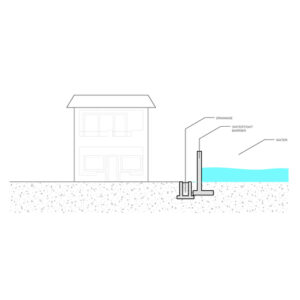
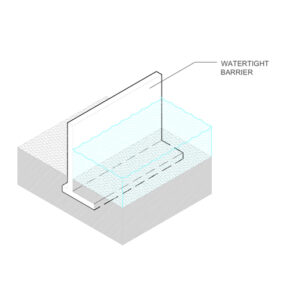
Watertight walls and permanent flood barriers are fixed structures designed to prevent floodwater from entering a building or protected area. Reinforced concrete walls, masonry barriers or engineered embankments create a continuous protective perimeter capable of resisting expected hydrostatic and other relevant flood loads.
Their effectiveness depends on structural stability, continuous watertightness and careful treatment of foundations, joints, openings and service penetrations.
Image
Please download the PDF to have the information sent directly to your email address.
Healthcare Waste Insulation
Send download link to:
Implementation Guide
- Determine the design flood conditions and required barrier height with an appropriate safety margin
- Design the barrier and foundations for hydrostatic loads, sliding, overturning, erosion and relevant impact forces
- Ensure continuous watertightness at walls, foundations, joints and service penetrations
- Provide watertight gates or protected access points where openings are required
- Incorporate drainage or pressure-relief measures where necessary without compromising the protected perimeter
- Inspect structural elements, joints and drainage systems after construction and major flood events
Benefits and Limitations
Benefits
- Provides a high level of permanent flood protection
- Can protect complete buildings or larger site areas
- Provides immediate passive protection without deployment
- Offers a robust and durable solution for predictable flood conditions
Limitations
- Requires significant structural and foundation works
- Can involve high construction costs and spatial requirements
- Discontinuities at joints, openings or penetrations can compromise protection
- May redirect floodwater or increase risk to surrounding areas if poorly planned
- Can create visual, landscape and access impacts
Parameter and data
Design: Permanent barrier extending above the design flood level with an appropriate safety margin, structurally designed for expected hydrostatic and relevant dynamic loads, with verified stability against sliding and overturning and continuous watertight detailing
Materials and Components:
- Reinforced concrete
- Masonry or engineered earth structures
- Steel reinforcement or structural elements
- Waterproof membranes or coatings
- Waterstops and sealantsWatertight gates or doors
- Structural foundations and anchoring systems
- Drainage or pressure-relief systems where required
Advantages: Provides robust, passive and long-term flood protection with high effectiveness when the protective perimeter is structurally adequate and continuously watertight
Maintenance: Medium: periodic inspection of cracks, joints, sealants, waterproofing, gates and structural condition, together with cleaning and testing of drainage or pressure-relief systems where installed
Environmental Impact: Medium–High: concrete, masonry, excavation and foundations can create significant embodied and site impacts, and barriers may alter natural water-flow patterns
Applicability Criteria: Suitable for buildings and sites exposed to predictable flood levels where permanent perimeter protection can be accommodated and the effects on surrounding flood flows have been assessed. Not suitable where space or foundation conditions are inadequate, or where redirecting water would create unacceptable flood risk elsewhere
Expected Service Life: 50+ years for the main structural barrier, depending on structural design, materials, exposure and maintenance. Waterproofing, sealants, joints, gates and movable components may require earlier renewal
Please download the PDF to have the information sent directly to your email address.
Healthcare Waste Insulation
Send download link to:





