
Description
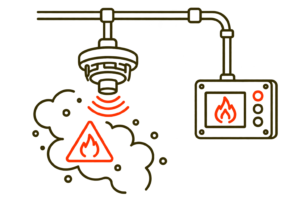
Flammable-gas or explosive-atmosphere detection systems monitor combustible gases or vapours and generate alarms before concentrations reach dangerous levels. This is a specialised wildfire-resilience measure for sites with LPG, natural gas, fuel storage or industrial processes that could be damaged by heat or fire.
It should not be treated as a universal requirement for ordinary buildings.
Image
Please download the PDF to have the information sent directly to your email address.
Healthcare Waste Insulation
Send download link to:
Implementation Guide
- Identify credible gas-release scenarios through hazardous-area and process risk assessment
- Select detector technology for the specific gas and environment
- Position detectors according to gas density, release points and ventilation
- Set alarm thresholds with reference to the lower explosive limit (LEL)
- Interface alarms with ventilation, shut-off valves or process shutdown where required
- Use appropriately certified equipment in hazardous zones
- Calibrate and bump-test detectors at the required frequency
Benefits and Limitations
Benefits
- Provides early warning of hazardous gas accumulation
- Can prevent secondary explosion after wildfire damage
- Enables automatic isolation and ventilation
- Protects industrial, fuel and energy systems
- Supports emergency decision making
Limitations
- Only relevant where a flammable-gas hazard exists
- Sensors require calibration and have finite life
- Different gases require different technologies
- High cost for complex sites
- Sensor poisoning or false alarms can occur
Parameter and data
Application: Fuel stores, LPG installations, plant rooms, industrial processes and other flammable-gas hazards
Detector Technologies: Catalytic bead, infrared, semiconductor or other gas-specific sensors
Alarm Basis: Thresholds expressed as %LEL, defined by risk assessment and applicable standards
Interfaces: Ventilation, shut-off valves, process interlocks and emergency shutdown
Hazardous Areas: Equipment must match any ATEX zone classification, gas group and temperature class
Expected Service Life: Control equipment 10-15+ years; sensing elements commonly 2-10 years
Maintenance: Bump testing, calibration, sensor replacement and interlock testing
Indicative Regulatory References: ATEX Directive 2014/34/EU; Directive 1999/92/EC where applicable; EN IEC 60079-29-1 / related standards; national process-safety rules
Please download the PDF to have the information sent directly to your email address.
Healthcare Waste Insulation
Send download link to:





